
Smart MCCB for Solar Power Systems

Designed for PV projects with strict grid stability and safety requirements, our Smart MCCB delivers rapid fault isolation and reliable grid interconnection.

SystemDiagram

Smart MCCB Placement in Solar Power Systems

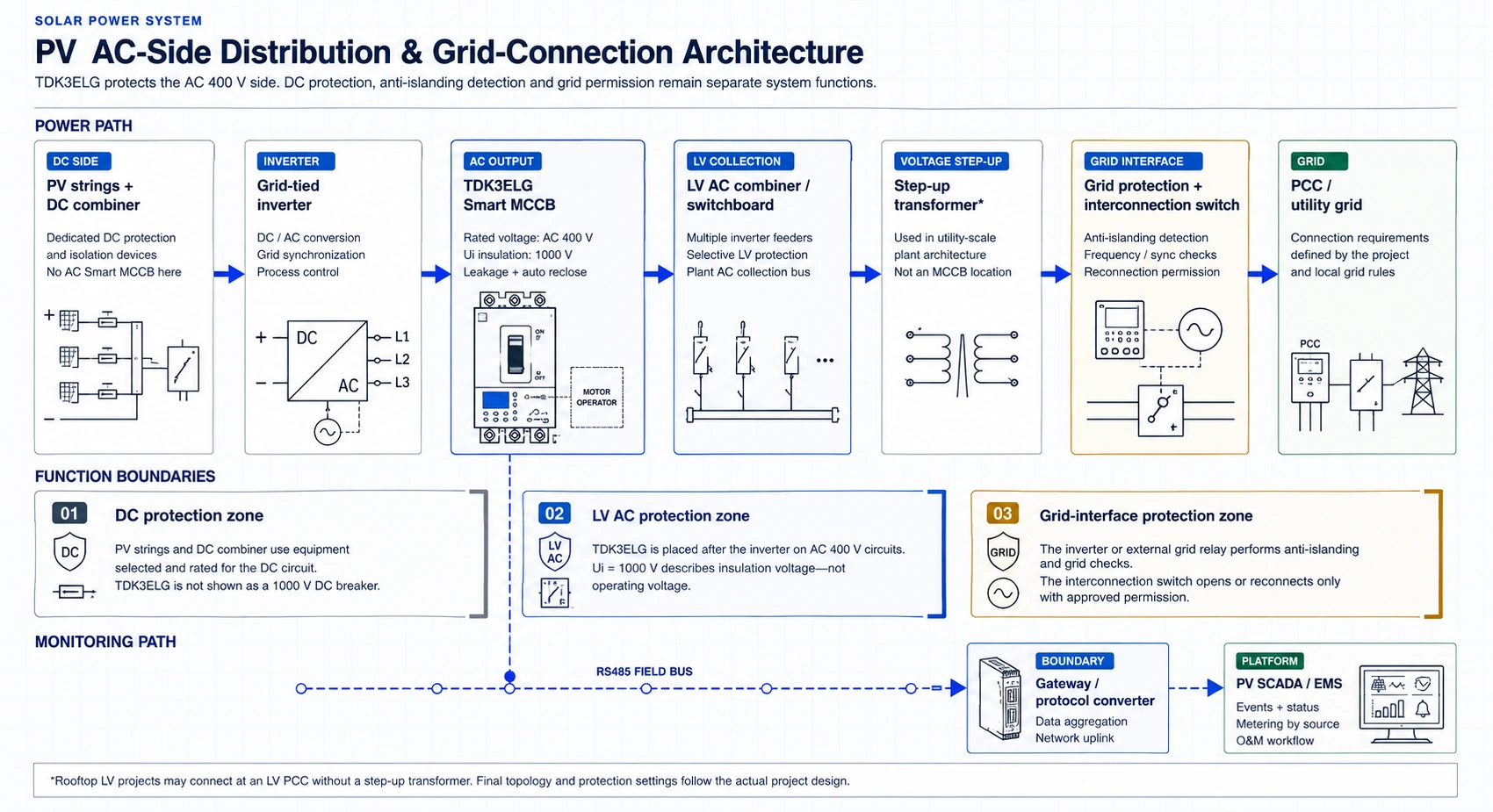
TDK3ELG is installed after the inverter on AC 400 V circuits at inverter outlets and grid-connection points. DC-side protection and the grid-interface relay remain separate parts of the PV system.

Why This Placement Matters

This placement protects the inverter AC output and supports selective LV coordination without using an AC MCCB in the PV string or DC combiner circuit.

  • Protects inverters and downstream AC equipment
  • Maintains stable operation under fluctuating PV output
  • Coordinates upstream and downstream AC protection
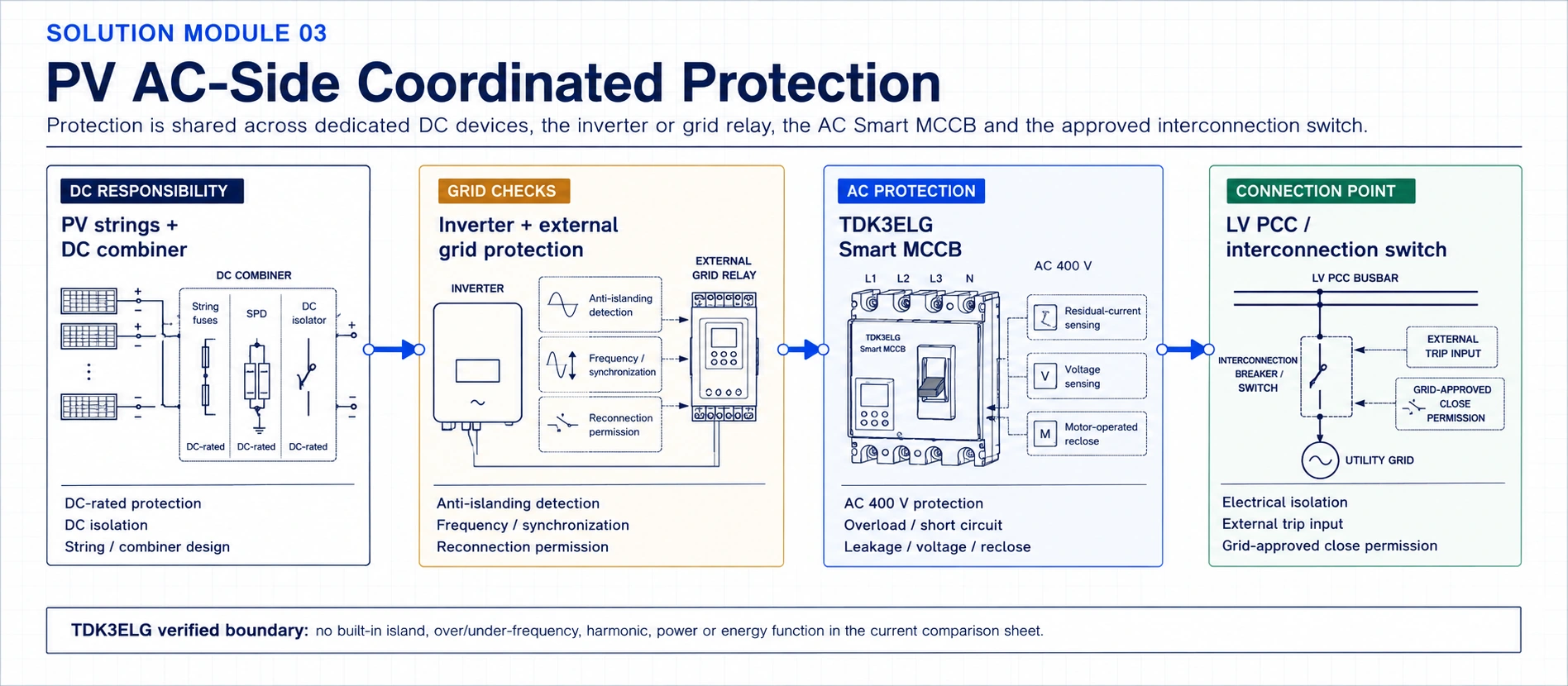
  • Separates DC, LV AC, and grid-interface protection zones

TDK3ELG has Ui = 1000 V insulation voltage, but its rated operating voltage is AC 400 V. Anti-islanding detection and grid permission remain with the inverter or external grid protection.

PV power architecture showing dedicated DC protection, grid-tied inverter, TDK3ELG on the AC 400 volt output, LV collection, grid interface, and a separate RS485 monitoring path
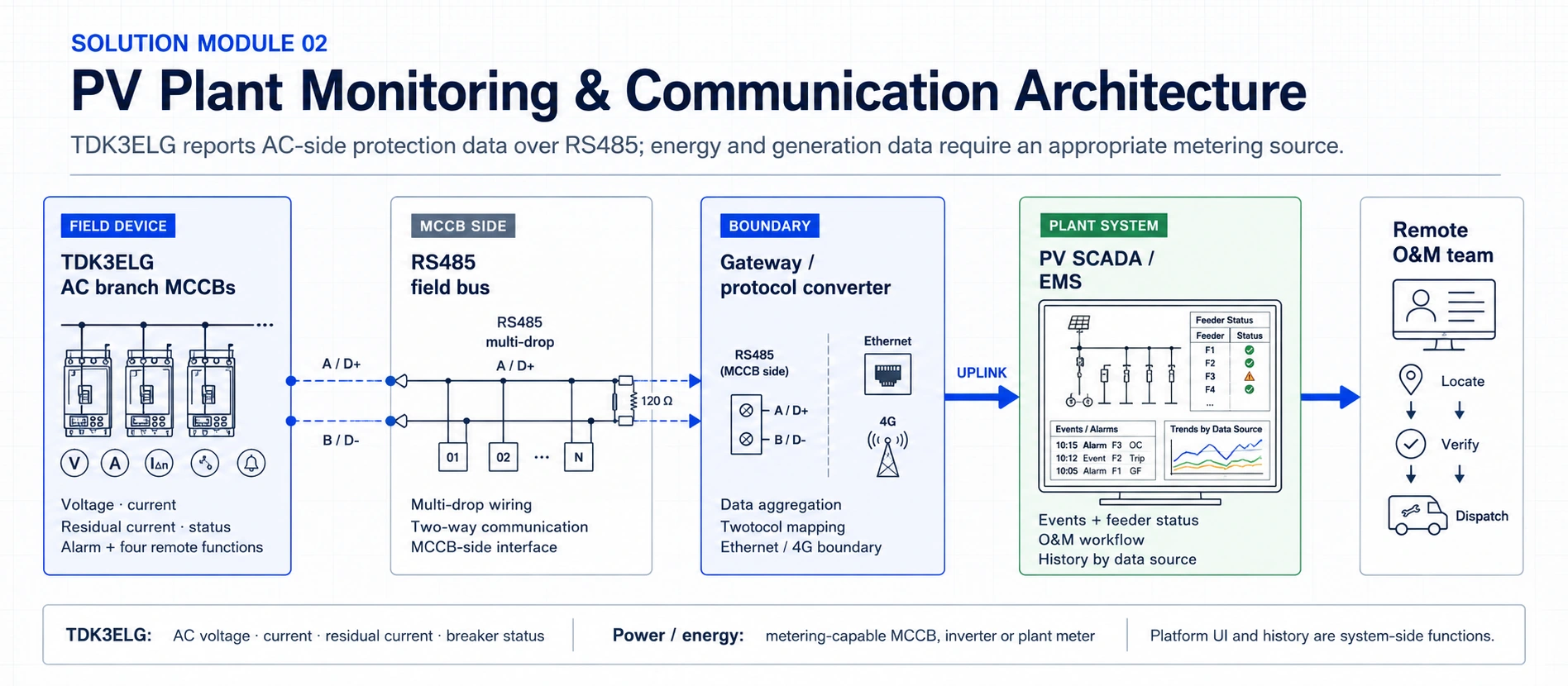
PV power and communication architecture showing TDK3ELG on the inverter AC output, external grid-interface checks, and RS485 connection through a gateway to PV SCADA or EMS.

Pain Points &Traditional Limits

Core Challenges for Solar Operators

  1. Grid connection requires anti-islanding and high insulation protection
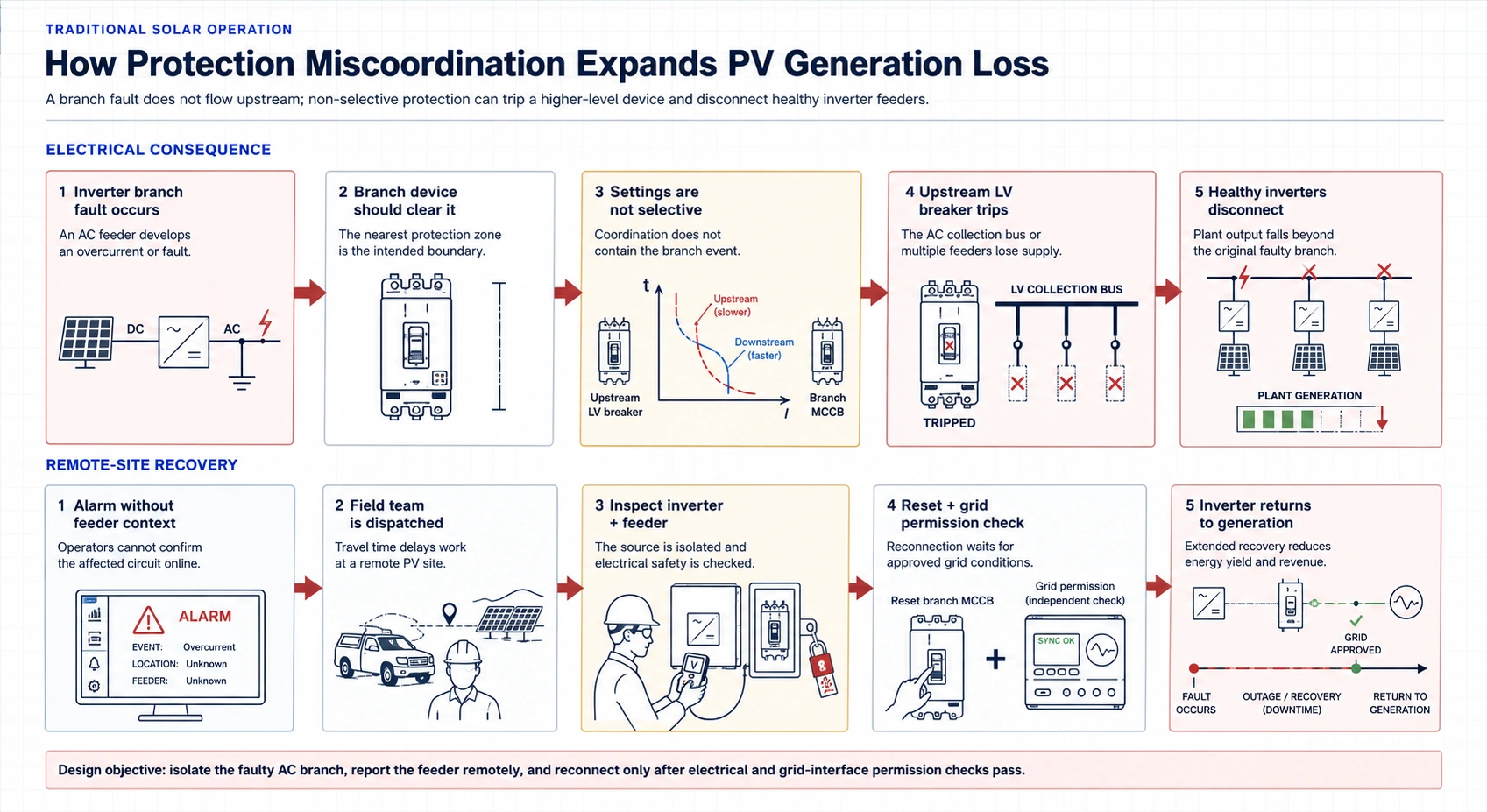
  2. Transient faults force repeated on-site restarts for remote PV stations
  3. Distributed PV needs full remote visibility of protection and operation data
  4. Equipment must fit both rooftop and large ground power stations
  5. Inverter-generated harmonics damage power equipment
  6. Maintenance cannot stop power generation and cause revenue loss

Drawbacks of Ordinary Breakers

  1. General breakers lack PV-dedicated protection functions
  2. No auto-reclosing leads to long generation downtime after grid surges
  3. Separate monitoring / protection / control devices lower O&M efficiency
  4. No built-in harmonic detection for inverter power systems
  5. Multiple devices raise cabinet occupancy and overall costs

ProblemVisualization

PV protection miscoordination flow showing an inverter AC branch fault, upstream LV breaker trip, wider generation loss, and remote-site manual recovery

Solution ModulesHow Smart MCCB Guarantees Stable PV Generation

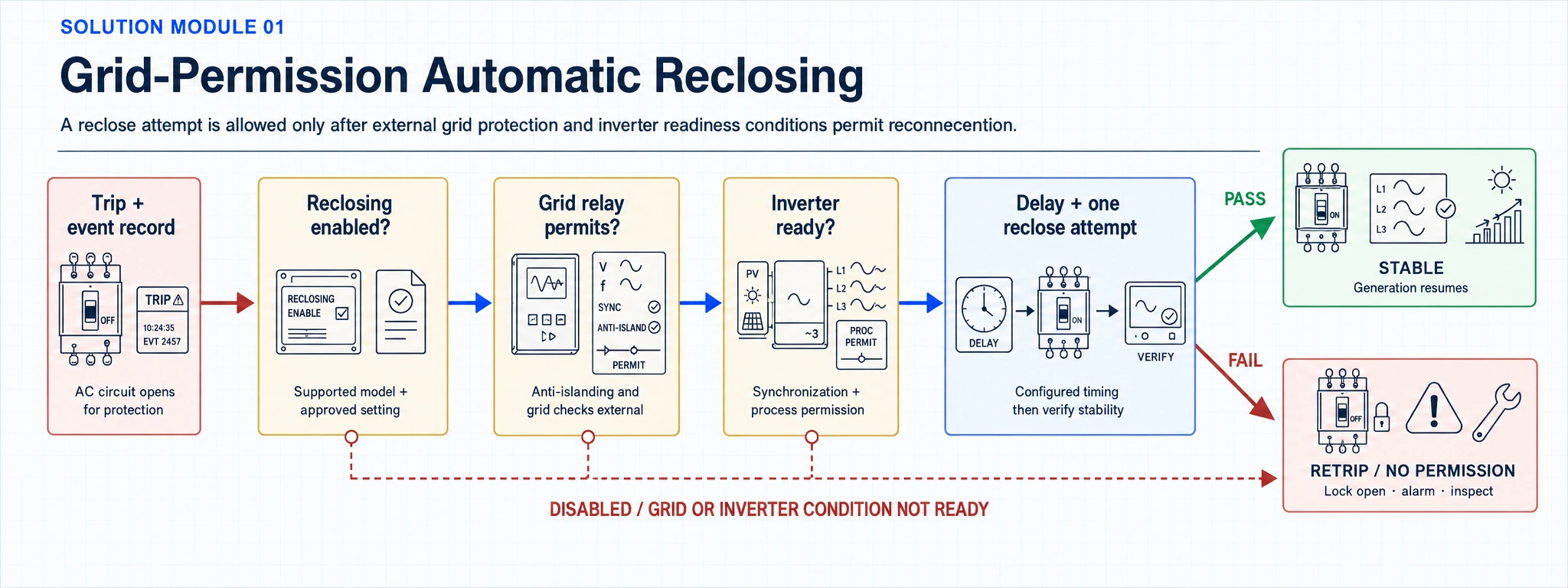
PV automatic reclosing flow with external grid relay permission, inverter readiness, configured delay, and stable or lockout outcomes
Module 01

Automatic Reclosing

Recover power quickly against grid surges and lightning faults

Grid fluctuation and lightning easily trigger PV system trips. TDK3ELG executes controlled reclosing after an adjustable delay of 20–60 seconds once external grid-protection and inverter-readiness conditions permit it.

Fault → Trip → Stabilization Delay → Controlled Reclosing

  • Cut generation downtime caused by transient faults
  • Eliminate on-site reset trips for remote PV stations
  • Secure reliable grid interconnection
  • Avoid frequent tripping and system oscillation
PV monitoring architecture from TDK3ELG and RS485 through a gateway to PV SCADA or EMS with separate metering sources
Module 02

Remote Real-time Monitoring

Full-station centralized monitoring for efficient O&M

All models support RS485 Modbus; Ethernet or carrier communication is optional. Compatible with PV monitoring and SCADA platforms to view voltage, current, power and fault alerts via a central dashboard.

  • Precise circuit-level fault positioning
  • Historical operating data for performance optimization
  • Remote parameter and firmware modification
  • Early warning of potential equipment failures
PV protection responsibility diagram covering DC devices, inverter and external grid protection, TDK3ELG AC protection, and the LV interconnection switch
Module 03

PV-Optimized Protection Suite

Complete protection customized for photovoltaic stations

  1. 3-stage overcurrent protection (overload / short delay / instantaneous)
  2. Overvoltage, undervoltage, phase loss and phase sequence protection
  3. Adjustable leakage protection (30–1000mA)
  4. Coordinates with inverter or external grid-relay anti-islanding
  5. Harmonic monitoring on selected metering models for inverter loads

ApplicationScenarios

Commercial & Residential Rooftop PV

Commercial & Residential Rooftop PV

Adopt PV-dedicated AC-side protection to secure distributed grid connection and leakage control.

Large Ground-Mounted PV Plants

Large Ground-Mounted PV Plants

Meet high insulation standards for main grid points with multi-layer protection coordination.

PV & Energy Storage Integrated Stations

PV & Energy Storage Integrated Stations

Integrate grid-side protection, auto reclose and metering to fit complex operating conditions.

RecommendedProducts

TDK3ELG

TDK3ELG

PV-optimized AC 400 V design with Ui = 1000 V insulation, leakage protection and auto reclosing. Best for inverter outlets, grid-connection points and distributed solar systems.

View Details
TDK3EL

TDK3EL

Leakage and auto reclosing for general PV branch circuits. Best for secondary AC distribution loops.

View Details
TDK4ELJ

TDK4ELJ

Flagship all-in-one: metering, leakage, reclosing and hot-swappable modules. Best for complex PV energy storage and large central stations.

View Details

Smart MCCB vsTraditional Breakers

Smart MCCB Integrated SolutionComparison CriteriaTraditional Setup
TDK3ELG with PV-focused AC protection and Ui 1000 V insulationPV AdaptabilityGeneric AC breakers without PV protection
Auto reclose within 20–60sFault RecoveryManual site reset, long power loss
Full remote real-time data via communicationO&M VisibilityOnly on-site manual inspection
Harmonic monitoring on selected metering modelsHarmonic ControlNo harmonic monitoring module
All-in-one, saves cabinet and wiring spaceSystem CostMultiple separate units

ProjectFAQs

Why select TDK3ELG as the priority PV model?

TDK3ELG is positioned for PV AC-side protection at AC 400 V and provides Ui = 1000 V insulation voltage, leakage protection, RS485, and automatic reclosing. Anti-islanding detection and grid permission must be supplied by the inverter or external grid protection.

Can one set fit rooftop and ground PV stations?

Yes. The same AC-side protection logic can be matched to rooftop inverters and larger plant connection points according to current rating, breaking capacity, and coordination settings.

Is remote O&M supported for distributed PV?

Communication-enabled models push breaker status, events, and alarms to the plant platform, cutting field inspection time for remote stations.

Can it connect existing PV monitoring and SCADA systems?

All units support RS485 Modbus with optional carrier communication. A gateway provides the boundary to Ethernet and mainstream PV monitoring or SCADA platforms.

Is auto reclosing safe for PV grid connection?

Reclosing is attempted only for approved circuits after external grid-protection and inverter-readiness checks. Transient events may restore; permanent short circuits remain open for inspection.

Does it meet large-scale PV grid standards?

Selective AC protection, event data, and coordinated reconnection support the electrical design. Final grid-code compliance depends on the complete PV system, inverter settings, and project interconnection study.

Get Custom PV Grid Protection Scheme

Provide inverter model, grid voltage, project scale and certification requirements; our electrical engineers will issue a tailored MCCB BOM.

Request PV Solution